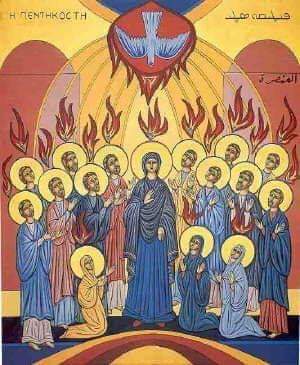
In the Christian liturgical calendar, the feast of Pentecost is observed ten days after Ascension Day and thus fifty days after Easter. It is one of the three most important Christian festivals, along with Christmas and Easter. It recalls and celebrates the descent of the Holy Spirit upon the followers of Jesus.
Pentecost was an important Jewish festival before it became a Christian festival. One of the three pilgrimage festivals that ideally were to be spent in Jerusalem, it occurred fifty days after Passover, the commemoration of Israel’s liberation from Egypt. It recalled and celebrated the giving of the convent to Israel on Mt Sinai. It was about the creation of a new kind of community—a way of living together radically different from life in Egypt. This meaning and the period of fifty days were brought forward into the early Christian understanding of Pentecost.
The central affirmation of Pentecost is that the Spirit promised by Jesus is now present among his followers and in the world. The Spirit is the Spirit of God, the Holy Spirit, the Spirit of Christ. This claim is foundational to the New Testament and early Christianity.
We see in Acts 2, a natural phenomenon occurs when the disciples of Christ numbering around 120 together with St Mary assembled there at a place in Jerusalem. The Spirit of God descends as fire and wind. Both are metaphors for God’s presence. The people from 15 different countries who were there around at that time could hear the disciples speaking in their own language, or rather a language universally understood. The happening on the day of Pentecost was a reversal of what had happened at the tower of Babel, which confused the world by dividing it into separate languages and countries, resulting in misunderstanding, rivalries and conflicts.(Genesis 11:1-15) Pentecost is the beginning of the unification of humanity.
The echo of Babel should not distract from the foundational meaning of Pentecost. It concerns the descent of the Spirit promised by Jesus and thus the continuation of his presence and the movement he had begun. The divine promise is that when the Spirit comes, He would guide us in truth and that He would convict the world of the guilt in regard to sin, righteousness and judgment (John 16:8, 13),
Over the 10 days prior to the feast of Pentecost, the church across the globe awaits the advent of the Holy Spirit in order to have the spirit in each one of the faithful renewed trusting and hoping in the prophetic promise from the holy Scripture. “Those who wait on the Lord shall renew their strength; They shall mount up with wings like eagles, They shall run and not be weary. They shall walk and not fain” (Isaiah 40:31).
In Psalm 51: 10, David the sinner prays thus: “Create in me a pure heart, O God, and renew a steadfast spirit within me. Do not cast me from your presence or take your holy Spirit from me”. Further, in Romans 12: 2b, St Paul, the apostle exhorts us to be transformed by the renewal of our mind. Every faithful ought to have their baptismal faith renewed by way of willingly and wishfully partaking in the divine liturgy and sacraments.
The main ritual associated with the divine service of the feast of Pentecost is the “sprinkling of water”. Water has a significant role in the sacramental rituals of the orthodox church. It is used as an element/property for purification and is held as the symbol of life and as a medium for the Holy Spirit to act upon the creation or interact with humanity.
In the Old Testament, sprinkling blood wasa vital, God-ordained ritual for atonement, purification, and covenant ratification, symbolizing the transfer of life to cover sin and sanctify people or objects. It typically involved using animal blood (bulls, rams, lambs) applied by priests to altars, holy items, or the people. (Exodus 24: 6-8. 29:20-21, 12:7, Leviticus 16:14-15, 14, 19).
In the New Testament Church, this type of ceremonial purification with the blood of animals has been replaced by the life-giving blood of Christ that was shed with water on the Cross of Calvary and its blessing is being made available even to the present time. It is to be noted that the very word “Blessing” is derived from the ‘act of sprinkling blood’.
In the Orthodox Syrian tradition, there is an elaborate order of liturgy on the feast of Pentecost. Three bowls of water with a bundle of basil leaves(Tulsi) are placed on the step near the holy Altar (Durga in Syriac) representing the three Persons of the Holy Trinity- Father, Son and Holy Spirit. The service consists of three parts: The first one is addressed to the Father, the second to the Son and the third to the Holy Spirit. After long liturgical prayers and hymns, everyone kneels down on the floor crying out Kyrie eleison (Lord, Have mercy on us!) It is believed that the spirit of God in a mystical way hovers over the water as He did on the waters at the very inception of creation (Genesis 1:2).
Then the celebrant priest sprinkles water upon the faithful attending the holy service. By this very act of sprinkling with water in the form of a Cross over the altar, the sanctuary, the nave and the congregation. It is a spiritual process of sanctifying or refining the old and defiled creation. This is in tune with the prayer of repentance by the psalmist which goes: “Cleanse me with hyssop, and I will be clean, wash me and I will be whiter than snow” (Psalm 51:7).
This, in other words, is the fulfilment of the prophecy from the book of the prophet Ezekiel 36:24-27. It reads thus: “I will take you from among the nations, gather you from all the lands, and bring you into your land. I shall sprinkle clean water upon you and you will be cleaned from all uncleanness and I will cleanse you from all your idols. I shall give you a new heart and put a new spirit within you. I shall take the heart of stone from your flesh and give you a heart of flesh. I shall put my spirit within you and cause you to walk in my requirements and you will keep my judgements and do them “. This, de facto, speaks about the baptism received by each believer. By participating in this ritual conducted as part of the service of the feast of Pentecost, the church as a whole renews the baptismal faith yearly.
The act of kneeling down during this service on the day of Pentecost is, in a way, re-dedicating ourselves before God Almighty. It helps us humble ourselves before the Lord, who is the Father of all, so that we may rise up with the power of God Almighty. (James 4:10, 1 Peter 5:6). During these solemn moments, Christ, by his love, makes us perfect and true worshippers of the Holy Trinity. This reminds us of the fact that by His God-pleasing resurrection, he has reformed and raised us from the fall of sin and cast off and put down our spiritual enemies under His feet. We are given the power to sing with confidence and stand before the fiery throne of God Almighty. By doing so, we acknowledge that we have already become worthy to offer Him worship in truth and spirit.
Ephesians 3:14 reads thus: “For this reason I kneel before the father, from whom his whole family in heaven and on earth derives its name, The family of God includes all who have believed in him in the past, all who believe in the present, and all who will believe in the future. We are all a family because we have the very same Father. He is the source of creation, the rightful owner of everything. God promises his love and power to his family, the church (Ephesians 3:16-21). If we want to receive God’s blessings, it is important that we stay in connect with other believers in the body of Christ. Those who isolate themselves from God’s family and try to go it alone cut themselves off from God’s power.
The Bible says “…that at the name of Jesus, every knee should bow in heaven and on earth and under the earth and every tongue confess that Jesus Christ is Lord to the glory of God the Father” (Philippians 2:10-11).
In brief, the celebration of the feast of Pentecost plays a vital role in the spiritual process of unification and purification of the whole of humanity and plays a definite role in bringing the creation and the creator together.


